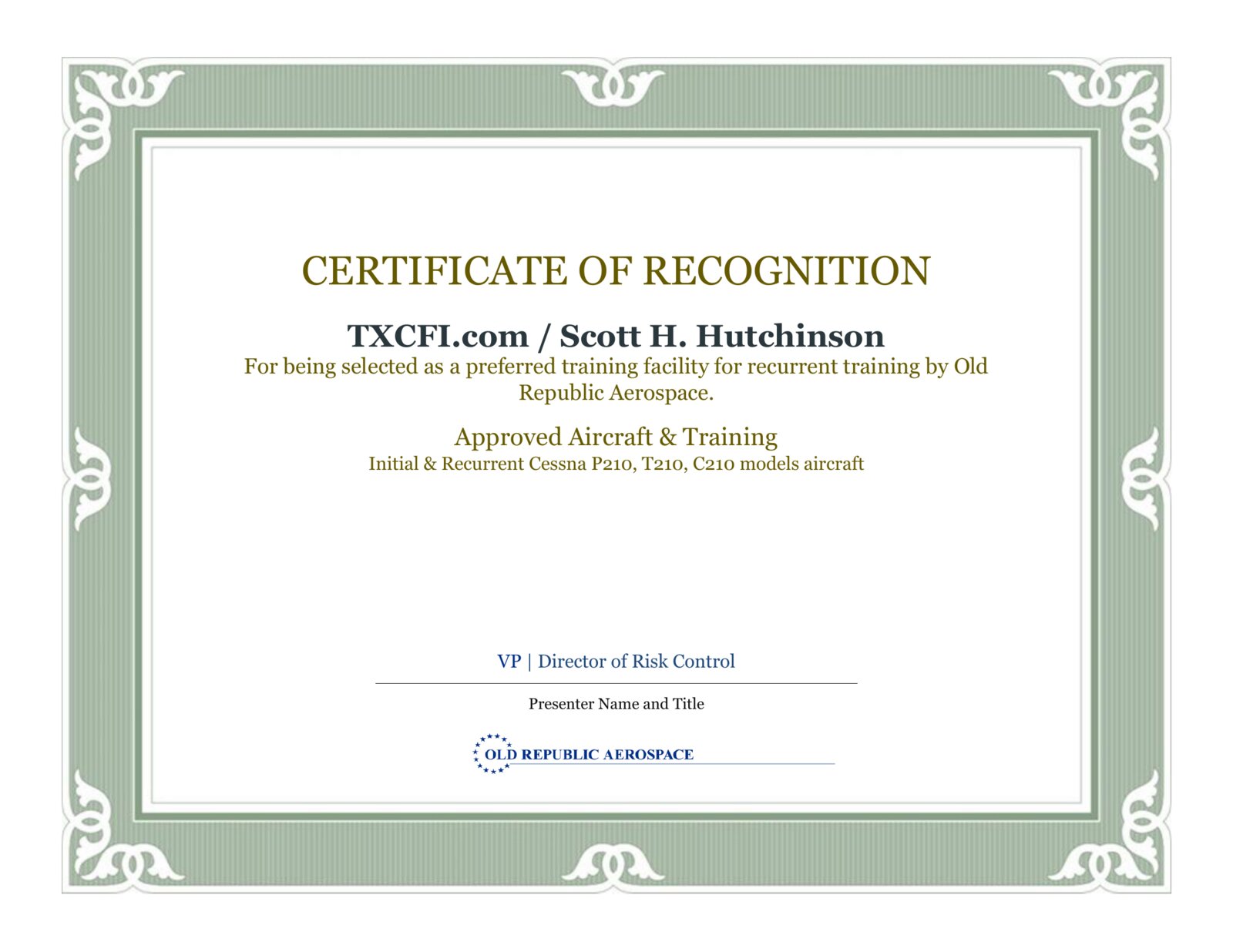
Old Republic Aerospace Certificate of Recognition for TXCFI.com / Scott H. Hutchinson, covering initial and recurrent training in the Cessna P210, T210, and C210

The Certificate of Recognition from Old Republic Aerospace. Some details have been removed for the web.

What Old Republic Recognized

Old Republic Aerospace's Flight Training Committee reviewed my application, my syllabi, and my pilot history forms. After that review, Old Republic recognized TXCFI as a select training facility for initial and recurrent training.

The Recognition

  • Recognized by: Old Republic Aerospace, Inc.
  • Reviewed by: Old Republic's Flight Training Committee
  • Training: Initial and recurrent
  • Aircraft: Cessna P210, T210, and C210

The P210 is a great airplane, but it's a single-engine, pressurized airplane that spends its time in the flight levels, and insurers treat it that way. Having an insurer's training committee go through my syllabus and records gives you one more way to know what you're getting before you hand me the keys.
Why It Matters to a P210 Owner

If you own a P210, your insurance policy likely spells out training: an initial checkout before you're added as a pilot, then recurrent training every year after that.

Your underwriter still makes the call on your policy. What this recognition does is show that an insurer's training committee has reviewed the program behind your training.

What the Training Covers

All training happens in your airplane, with your avionics, tailored to how you actually fly it.

Initial Training

For new owners and pilots new to the P210. It includes the full 210 transition curriculum plus:

  • High-altitude physiology — Hypoxia recognition, time of useful consciousness, and your own SpO2 baseline with a pulse oximeter.
  • Pressurization system — How the electric, pneumatic, and mechanical pieces work together, where leaks come from, and how to troubleshoot.
  • Emergency descent — Three techniques (the published procedure, a steep spiral, and a partial-flap descent) and when to use each.
  • Engine failure at altitude — What else goes with it at FL200: vacuum, boots, battery time, and a harder restart.
  • Oxygen system — How the generator system works, how it fails, and its one-use limitation.

Initial training culminates in a cross-country of 200+ nm at FL200 or higher and an IFR landing at a Class B primary airport.

Recurrent Training

For current P210 pilots meeting their annual requirement. We start with a review of your flying since last year, then work on:

  • Systems refresher — The knowledge that fades: fuel system details, gear operation, and circuit breaker locations.
  • Maneuvers to standard — Steep turns, slow flight, stalls, and short and soft field work.
  • Emergency procedures — Manual gear extension, simulated engine and electrical failures, and flap malfunctions.
  • IFR proficiency (if applicable) — Approaches, holds, partial panel, and missed approaches.
  • P210 specifics — Pressurization operation, emergency descent practice, and a climb to FL180+ when weather permits.

Recurrent typically takes 3–5 flight hours plus ground review.

Documentation You Can Hand Your Underwriter

When we finish, you'll have the syllabus, flight records, and an insurance-ready endorsement, plus Flight Review and IPC endorsements if applicable. Training is conducted to ACS standards, not minimums.

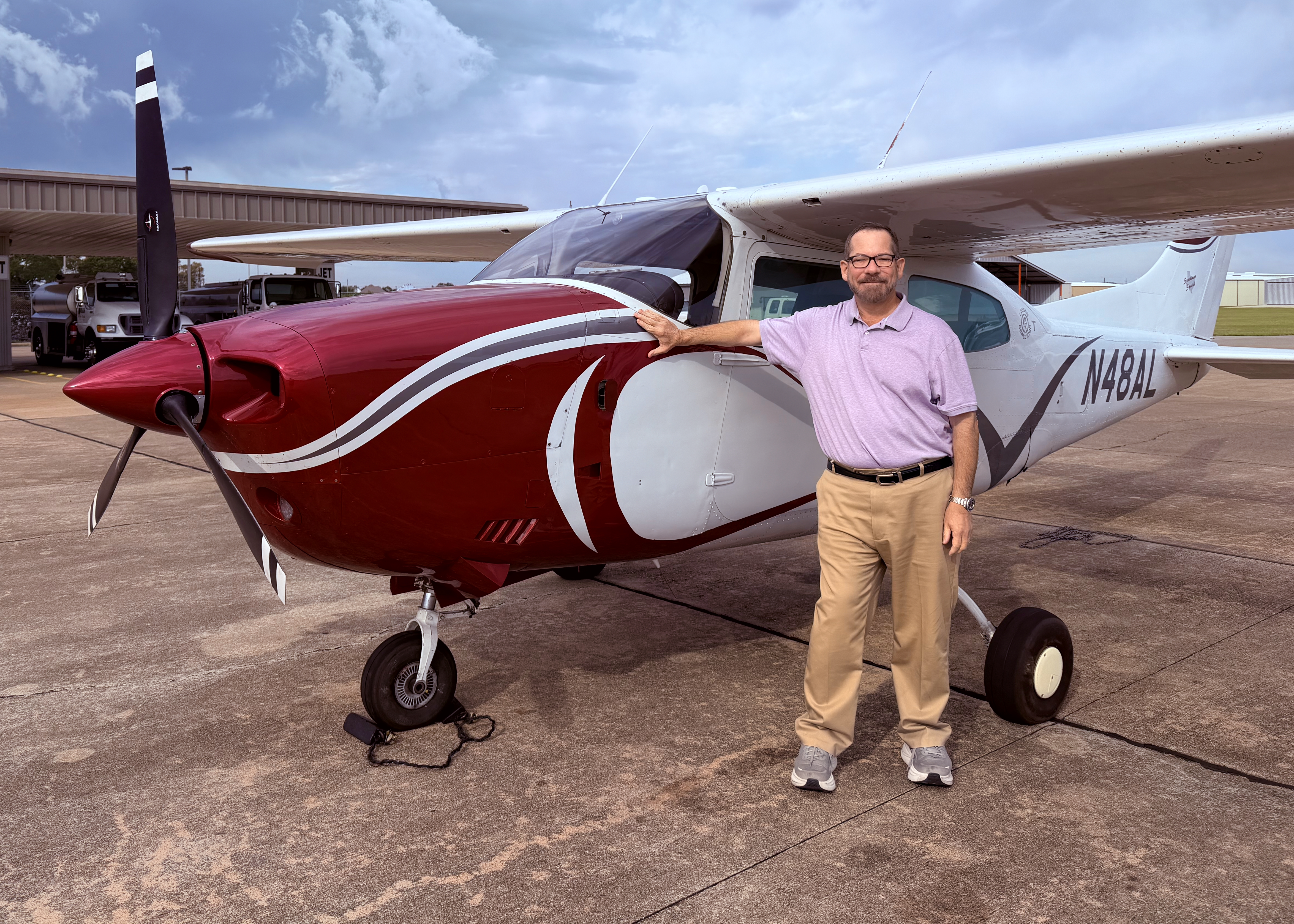
Scott Hutchinson with a Cessna 210

Who You'll Fly With

I'm Scott Hutchinson, a Gold Seal CFII and SAFE Master CFI. I have 3,500+ hours total and 1,500+ hours in Cessna 210s, including more than 400 hours of transition training across the C210, T210, and P210.

I'm based at KIWS (West Houston Airport), but I travel to you. Training happens in your airplane, at your home airport, on your schedule.

More About Me

Need Initial or Recurrent Training in Your P210?

Tell me about your airplane, your insurance requirements, and where you're based. I'll get back to you with a plan.